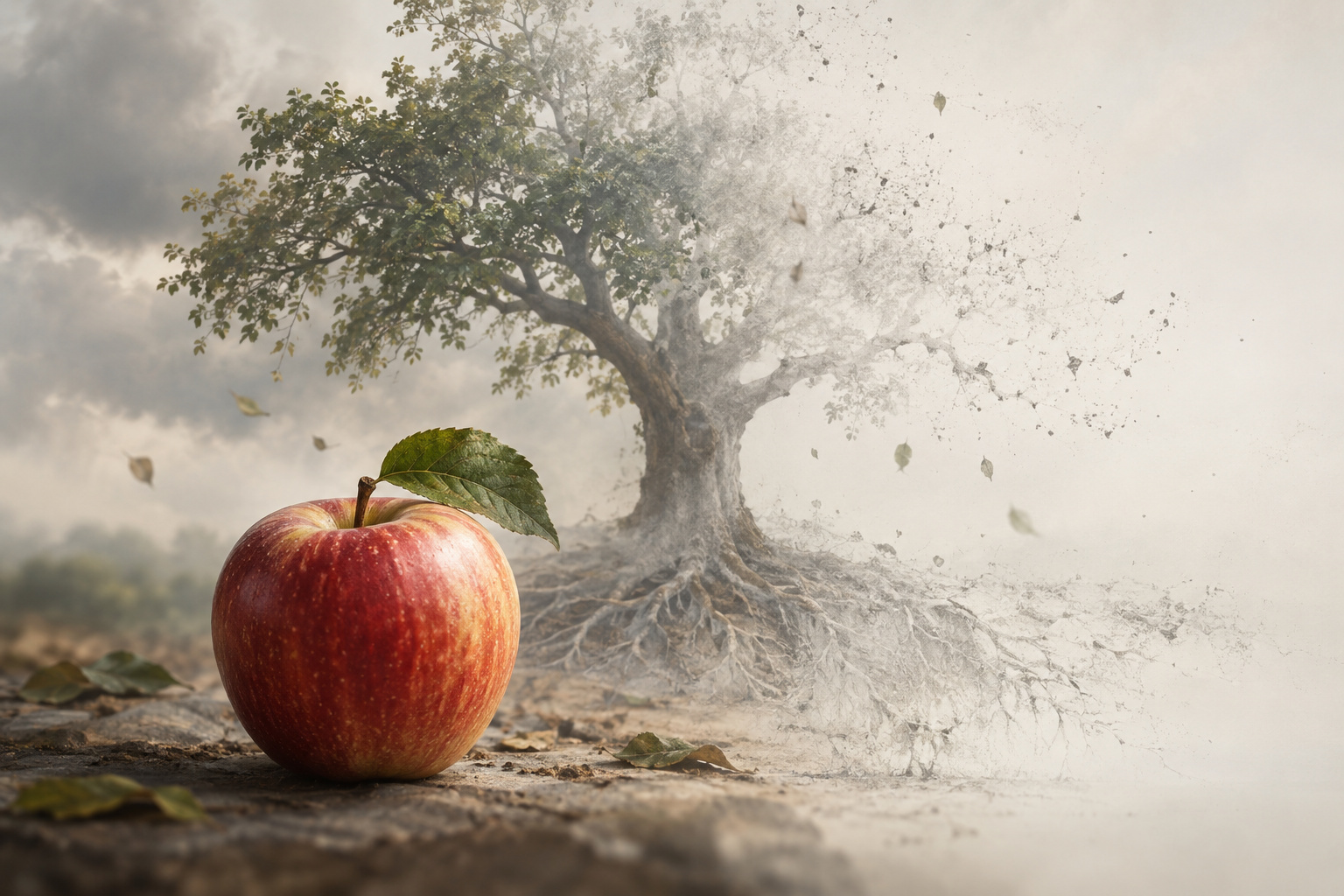
Imagine a tree. A fruit has appeared on the tree. The fruit can be separated from the tree, held in one’s hand, named, classified, and measured. And then something strange happens: the tree disappears. Not physically, of course. It disappears from the construction of the result’s origin.
The fruit remains. And everything that came before it begins to be perceived as something formless, transitional, strange, and not particularly significant. As though there had been some collection of branches, leaves, roots, and processes, and then, at last, the real thing appeared: the fruit.
But the fruit did not arise instead of the tree. The fruit arose from the tree.
And if the subject loses this distinction, the result begins to look as though it appeared practically on its own.
The Result Rewrites Its Own Past
Once a result exists, the subject gains the possibility of looking at what preceded it through that result. Now we know what emerged. Now we can trace a line backward and divide what came before in relation to the result that arose: this led to it, this proved useful for it, this is what the subject calls a mistake, this is a dead end, and this was altogether unnecessary.
But such a division arises only from the standpoint of an already existing result.
Initially, there is a certain space of possibilities, distinctions, questions, contradictions, attempts, and connections. Different forms may emerge within it, while some possibilities may never take on a separate form at all. Then one of the forms that emerged becomes the point through which the subject begins to describe retrospectively the space from which that very form arose.
Thus the statement “result X emerged from conditions A” imperceptibly turns into the statement “conditions A were the process of creating X.”
But these are completely different statements.
That X arose from A does not imply that A existed for the sake of X. It does not even imply that X is the main content of A. Still less does the very emergence of X turn everything that existed within A into stages of movement toward X.
What Has Emerged Appropriates Its Own Origin
When a result becomes sufficiently stable, its connection to the conditions of its emergence can disappear almost completely. Then what remains is no longer “this arose from that,” but “there used to be some strange, murky, and incorrect thing, and then a normal thing appeared.”
Genesis itself disappears.
This mechanism is particularly visible in the relationship between philosophy and science. A modern subject may perceive philosophy and science as two independent fields between which a successful separation once occurred. Philosophy was concerned with talk and abstractions. Science finally turned to verifiable knowledge. Science separated from philosophy. And it is a good thing that it did.
In this picture, the question almost completely disappears: within what, in the first place, did the distinction that later came to be called science emerge?
Science did not appear alongside philosophy as a ready-made alternative system. What would later take shape as separate fields of scientific knowledge emerged within a much broader space of inquiry into nature, causality, motion, matter, knowledge, proof, and observation.
But once a separate form emerges, it becomes possible to look backward and say: here there was already science, whereas here there was still some kind of philosophy.
The result creates its own boundary and then projects it into the past. Consequently, the space from which the result grew ceases to be perceived as the space of its emergence. It becomes simply “what existed before the result.”
And that is a completely different meaning.
Philosophy Becomes Incomplete Science
Another substitution takes place here. After the emergence of science, philosophy can begin to be assessed by the criteria of science. Is it testable? Can it be measured? Can it be experimentally confirmed? Can a reproducible result be obtained?
If not, the conclusion follows: then it is not genuine knowledge.
But these criteria already belong to the form that has taken shape. The subject takes the criteria of the result and applies them to the space within which those very criteria were once only beginning to emerge.
The construction is almost circular. First, a narrow form emerges from a broader space. Then this form creates its own criteria of correctness. And then those criteria are used to measure the space from which the form emerged. Naturally, the original space turns out to be “incorrect.” It could not have met the criteria of a form that only appeared later.
In this way, a tree can be declared a bad apple. The tree does not have the form of an apple. The tree has a different structure. One cannot eat a tree the way one eats an apple. Therefore, the tree performs the function of an apple poorly.
The absurdity becomes obvious only because, in the case of the tree, the subject retains the distinction between the source of emergence and the result. In relation to knowledge, this distinction is lost much more easily.
What Has Not Taken Form Becomes an Error
The most radical part of this mechanism begins where everything that has not acquired a stable form starts to be perceived as something that has no existence in its own right.
If a particular line of inquiry led to a stable theory, the theory remains. Questions that did not lead to it disappear. Distinctions that were not developed further disappear. Alternative directions disappear. Connections that never took form disappear.
Later, the subject sees only what has retained a form, and the illusion arises that precisely this was the content of the original space.
But what has survived is not identical to what existed. And what has taken form is not identical to everything from which it might have emerged.
What has not taken form is not a failed version of what has taken form.
This is one of the principal distinctions here.
Before a particular form appears, it is impossible to define everything that existed solely through its relation to that form. If X has emerged, that does not transform everything else into “not-X,” because before X emerged, that very opposition did not yet exist.
That is why the result does not merely stand out from the past. It can begin rewriting the past as though the past had already been organized around it.
The Fruit Is Not the Meaning of the Tree
The fruit is one of the tree’s manifestations. But as soon as the subject declares the fruit to be the result, a danger arises of taking the next step: since there is a result, everything that preceded it must have existed for its sake.
It is precisely here that the tree imperceptibly becomes an apple production line. The roots are needed to produce an apple. The leaves are needed to produce an apple. The branches are needed to produce an apple. The entire tree begins to be described exclusively in terms of a single fruit that has emerged.
But the tree is more than any particular fruit. It contains not only the result that has already emerged, but the very capacity for emergence. Other fruits might have appeared on it. Some branches might have grown differently. Some things might never have acquired a separate form at all. And none of this can be retrospectively reduced to the function of producing one particular apple.
Likewise, the space of philosophical inquiry cannot be reduced to the function of producing modern science. The process of thinking cannot be reduced to the function of producing an idea that has already been found. A multitude of questions cannot be reduced to the function of producing the answer that happened to become historically established.
The conditions of emergence cannot be reduced to the result.
The Disappearance of Genesis Creates an Illusion of the Result’s Independence
Once the conditions of emergence are erased, the result begins to appear self-sufficient. There is a scientific method. There is a theory. There is a discipline. There is a concept. There is a technology. There is a ready-made form.
It seems that one can simply take it as a given.
But something becomes a given only after the subject has ceased to see the process of its emergence.
Every stable form conceals the fact that at one time it was not a stable form. Its boundaries did not exist. Its criteria did not exist. Its language did not exist. Distinctions that now seem obvious had not yet been made.
That is precisely why a ready-made form creates the danger of a historical illusion. The subject begins to look at the past as though the past already knew the categories of the present.
As though philosophy had always been philosophy in its modern opposition to science. As though science had always existed as a separate entity and had simply emerged from philosophy one day. As though a ready-made boundary had existed and only needed to be discovered.
But the boundary itself is a result.
The Result Does Not Explain the Conditions of Its Own Emergence
The emergence of a form shows that such a form could arise under the given conditions. But it does not reveal all of those conditions. Still less does it exhaust them.
One apple is not an explanation of the tree. One theory is not an explanation of the space of questions from which it arose. One scientific discipline is not the exhaustive content of the space of inquiry within which it took shape.
A single result cannot retrospectively declare itself the sole meaning of its own origin.
And if the subject allows it to do so, the subject loses precisely that space from which anything new can emerge at all.
Because the new almost always initially looks nothing like a ready-made result. It exists as a question, as a contradiction, as a distinction not yet made, as a connection that does not yet have a name, as a movement of thought for which no finished product can yet be presented.
If only what has already acquired a form is recognized as existing, the subject begins destroying the conditions for the emergence of the next form.
The subject preserves the fruits and cuts down the trees.
The Result Is a Consequence of Its Conditions, Not Their Owner
The main distinction here can be stated very briefly:
The result emerges from conditions, but this does not give it the right to determine what those conditions were.
The conditions existed before the result. The result is one of the things that emerged from them. Therefore, one cannot move backward from the result and declare: this was its preparation, this was a mistake, this was unnecessary, this did not matter.
That is no longer a description of the process. It is a reconstruction of the past from a standpoint that appeared later.
This is how the fruit appropriates the tree. This is how a theory appropriates the space of inquiry. This is how science can erase philosophy from its own origin. This is how what has taken form begins to deny what has not yet had a form.
But the tree was not a draft of the fruit.
Philosophy was not a draft of science.
A question is not a draft of an answer.
What has not taken form is not a defective version of what has.
The result does not create its own origin. It emerges from it.


