
Duality as the Explosion of Ontology
Introduction Many philosophical systems, scientific theories, and religious worldviews all attempt to answer the same question: what is primary? Matter
Deconstruction of Reality is a philosophical research project concerned with ontology. It develops methods for investigating reality as such, the subject, consciousness, existence, meaning, knowledge, and action, as well as the ontological relations among them. This list does not exhaust the scope of the research.
The research develops as new distinctions and questions emerge. Its subject matter is not necessarily given in advance: identifying a subject of inquiry, its boundaries, and its relations may itself be part of the work. The concepts, categories, and methods used in the project also remain open to investigation and revision. The published topics show the path taken so far, but do not set limits on future work.
The published research advances certain ontological propositions. Reality is understood as thesis-free: no concepts or statements about reality establish its ontological boundaries. Consciousness is understood as a fundamental aspect of being that participates in making distinctions and forming meaning. These propositions are developed and argued for in the project's publications; they are not presented as an exhaustive account of everything that exists. The project also investigates whether the existence of a particular reality can be conditioned by a subject's act of distinguishing it.
Subjectivity has a central place in this research. It concerns how a subject understands what is happening, enters into relations, makes decisions, and organizes activity. In acting, a subject creates and uses forms such as concepts, models, norms, procedures, and institutions. These forms can express meaning and help organize activity. The question then arises: under what conditions does a form begin to determine what is possible for the subject and subordinate the meaning for which it was created to its own reproduction?
The project's mission is to restore the subject's capacity to investigate reality independently, to distinguish reality from the constructs created within it, and to preserve the priority of meaning over form. This calls for attention both to the subject of inquiry and to the grounds on which it is explained. A new distinction may call for a revision of an existing understanding, a different model, or a question left open. The same possibility must remain open for the project's own ontological propositions and methods.
The full mission and research program examines categorical closure: how the categories we create come to determine which questions can be asked, and what allows inquiry to remain open. It considers the consequences for knowledge, human action, and social life.
Holding a distinction in the unknown is a research method developed within the project. A distinction is held without being identified with any particular category. Concepts, models, and explanations may be introduced to work with it, depending on the research task. These constructs are provisional by nature: they make inquiry and action possible, but neither exhaust the distinction nor remove the unknown. The same distinction may be defined differently for different tasks, without any requirement to reduce those definitions to one final form.
Holding a distinction in the unknown as a method of inquiry (Russian)
This line of research examines the relation to another subject and the relation to reality. A relation that preserves subjectivity remains possible when another subject or reality is allowed to be a source of a new distinction that may call existing categories into question. An objectifying relation arises when everything they might bring is presumed in advance to fit established categories, for example when a distinction raised by another person is immediately classified as “their opinion.”
Such a relation draws on the method of holding a distinction in the unknown (Russian): a new distinction is held without identifying it with a final definition. Concepts and models allow us to work with what is happening while remaining provisional constructs shaped by the task. When a working definition acquires final status, the subject also narrows the range of their own possible responses. This line of research connects objectification and self-objectification, asymmetry in relations, the conditions of dialogue, and the Flat Mind / Deep Mind modes.
Subjectivity and relations: research questions and related materials (Russian)
These publications offer several entry points into the existing work. Each addresses a specific question and can be read on its own or returned to later.
On the limits of description and the relation between reality and the forms through which it becomes understandable.
An inquiry into responsibility in relation to subjectivity and action.
How a subject organizes activity and how this relates to forms of collective action.
How a form created to express meaning can come to appropriate it and demand its own reproduction.
The Engineering Leadership Program (Russian) connects research into subjectivity, responsibility, and the organization of activity with engineering practice.
The ontology collection (Russian) brings together ontological research. The materials archive provides access to published documents and their existing collections.
Introduction Many philosophical systems, scientific theories, and religious worldviews all attempt to answer the same question: what is primary? Matter

I. When Motion Is Born from Within Classical mechanics long believed that motion was the result of an external push.
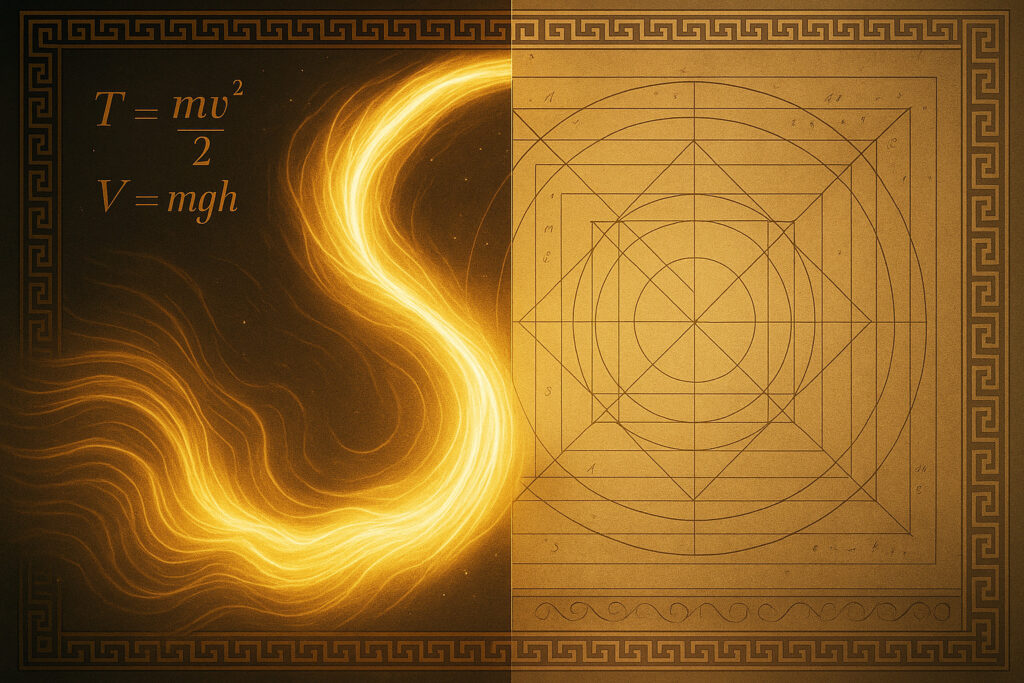
1. From Philosophy to Mechanics Before physics appeared in the modern sense, the word energy had a philosophical meaning. For

The end of the nineteenth century marked the apotheosis of the mechanistic worldview. The universe appeared to be a perfect

Abstract The story of the Tower of Babel is not just an ancient myth—it is an archetypal scenario through which
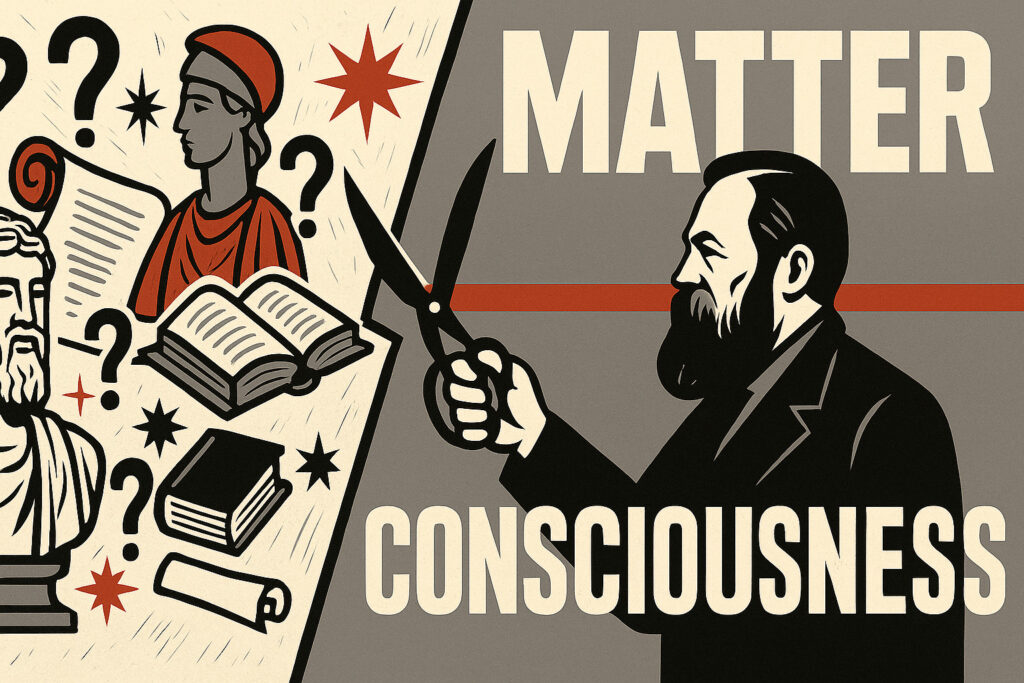
Introduction Soviet philosophy textbooks routinely asserted that “the fundamental question of philosophy is the question of the relation between matter

Introduction The idea of the Earth as a flat disk or slab is one of the oldest in the history

A rhetorical trick is a tool for winning a debate;a philosophical argument is a search for truth regardless of the

Introduction Skepticism is one of the most influential philosophical traditions, which questions the possibility of attaining absolute truth and reliable


