How the Program of Physical Explanation Became a Claim About the Boundaries of Causality
Today, the principle of the causal closure of the physical frequently appears in discussions of consciousness almost as an established scientific fact. It may be formulated approximately as follows:
Every physical event that has a cause has a sufficient physical cause.
There are stronger and weaker versions of this formulation, but the general construction remains: if one traces the causal history of a physical event, completing that history does not require going beyond the physical domain.
And this is precisely where the problem of genesis begins.
This formulation gives the impression of a result that physics reached after investigating the world: physicists supposedly gradually discovered all the necessary causal connections, investigated the organism, then the nervous system, then the brain, and eventually established that the causal structure of the physical world is completely closed within the physical.
The history is considerably more complicated.
The idea from which modern causal closure grew arose long before modern neurophysiology. Its early forms existed even before the emergence of the modern concept of energy itself. In the nineteenth century, it became a methodological program in physiology. In the twentieth century, it became associated with physicalism and then turned into one of the central assumptions of analytic philosophy of mind.
It is therefore insufficient to investigate causal closure solely as a thesis of contemporary philosophy of mind. We need to reconstruct the path along which the very form of the question arose.
Not merely:
“Is the physical world closed?”
But:
“Where did the idea come from in the first place that reality can be divided into a physical domain and everything else, and that one can then ask whether the former is causally complete?”
1. What Exactly Does Causal Closure Assert?
First of all, causal closure is not identical to determinism.
It does not necessarily claim that the state of the universe at time \(t_1\) uniquely determines its state at time \(t_2\). Contemporary versions may accommodate probabilistic laws.
Nor does it necessarily assert that nothing nonphysical exists.
One can, for example, allow consciousness to exist as a distinct phenomenon while maintaining that it contributes nothing to physical causality.
The minimal structure of the thesis is different:
A physical causal description is sufficient to account for a physical effect.
And this already contains several operations.
First, a boundary is drawn, and a domain called “the physical” appears.
Then a class of events is defined within this domain.
Then a relation of causation is introduced.
Then the notion of a sufficient cause arises.
And finally, a universal claim is made: for any physical effect, a sufficient causal basis can be found within that same physical domain.
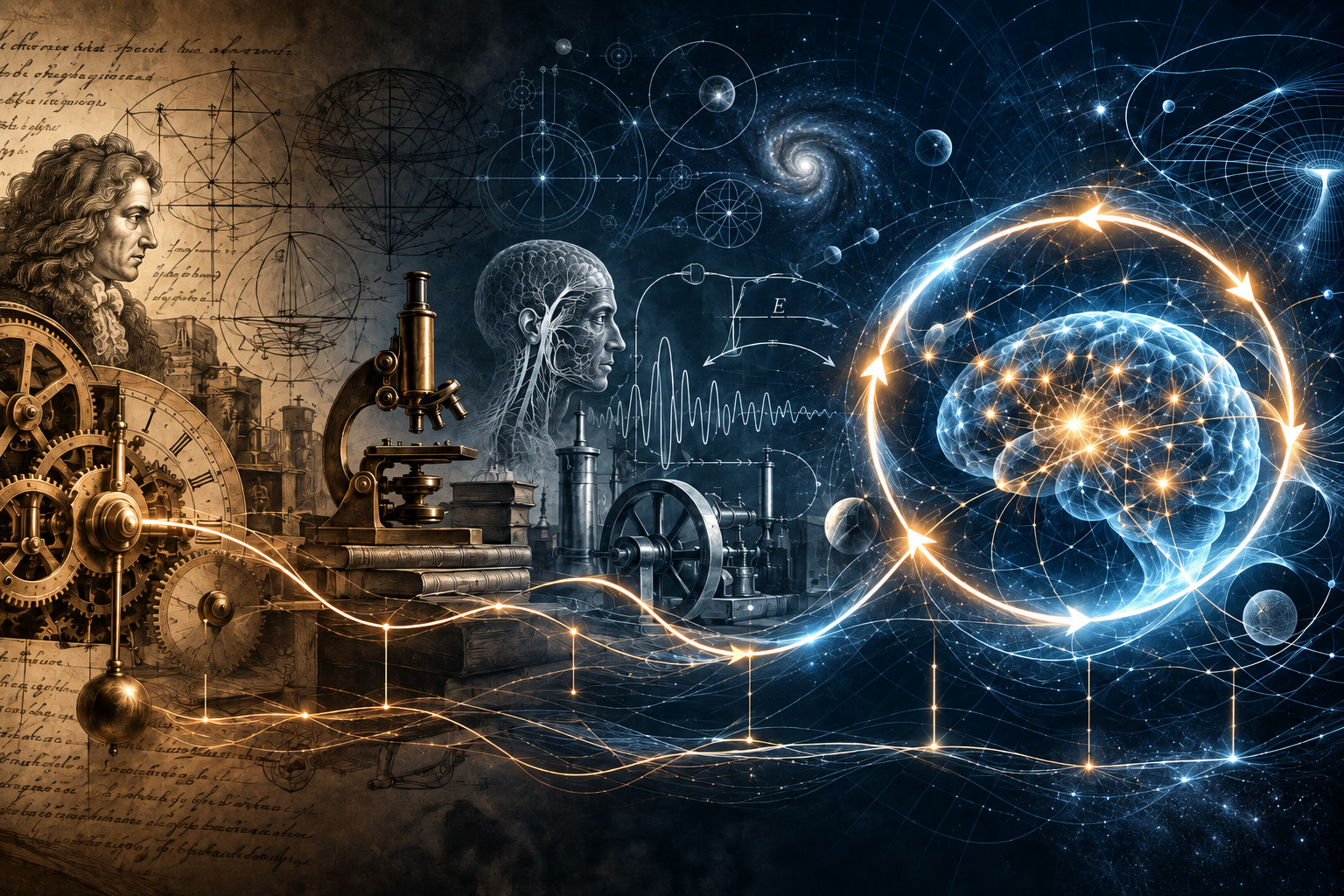
The result is a kind of causal ring:
physical → physical → physical → physical
One can continue indefinitely along the causal chain without leaving the chosen space of description.
This is why the expression closure is so important. It is not merely a matter of physical causes existing. It is about closing the space of causal explanation upon itself.
2. The Seventeenth Century: The Mechanical World Was Not Yet Causally Closed
One of the early sources of the future problem appears in the mechanical philosophy of the seventeenth century.
Descartes already introduces an exceptionally powerful division: extended matter and thinking substance. The body can be described mechanically. The motion of bodies obeys laws. The organism can be regarded as a mechanism in many respects.
But this is not yet modern causal closure.
The reason is simple: Descartes simultaneously allows for interaction between soul and body.
In other words, Descartes’s physical machine still has a door.
A person can decide to raise an arm, and this decision somehow participates in changing the body’s motion.
A tension already arises here. If the motion of a physical body obeys its own laws, what exactly happens when an unextended soul acts upon it?
But the very formulation of the question shows that the causal autonomy of the physical had not yet been accepted as an initial truth.
A physical description could be mechanical and extraordinarily rigorous while still remaining causally open.
And it is precisely this openness that becomes the problem for the next step.
3. Leibniz: The Structure of the Argument Already Appears in the 1690s
A very important turn occurs with Leibniz.
As early as the 1690s, he uses laws of conservation of motion and his own conception of the conservation of vis viva, a historical predecessor of the concept of kinetic energy, against Cartesian interaction between soul and body.
The logic is recognizably modern.
If physical changes already obey laws of conservation, then an additional influence of the soul on bodily motion becomes problematic. Leibniz explicitly associated the possibility of the soul’s physical action with a violation of the laws of nature. Contemporary historians of philosophy of mind therefore regard his reasoning as an early relative of today’s causal exclusion problem.
This occurs approximately two and a half centuries before modern neuroscience.
And Leibniz’s own conclusion was not materialist.
He did not say:
“Therefore, only the physical exists.”
His solution was different: pre-established harmony.
The mental and the physical develop in coordination, but do not act directly upon each other.
This is an exceptionally revealing historical moment.
The very logical form later used to justify physicalism did not originally lead to physicalism at all.
The structure of the argument had already appeared:
If a physical sequence possesses its own completeness, no causal work remains for an additional nonphysical cause within it.
But the ontological conclusion is still open.
One can arrive at pre-established harmony.
One can arrive at epiphenomenalism.
Later, one can arrive at identity theory.
Still later, one can arrive at supervenience or other varieties of physicalism.
Causal closure and physicalism, therefore, are not historically the same assertion. Causal closure becomes a construction that creates pressure toward certain ontologies, but does not itself determine the only possible answer.
4. The Eighteenth Century: There Was Still No Definitively Closed Physics
It is important not to turn this history into a straight line:
Descartes → Leibniz → physics proved closure.
No such line existed.
Even after Newton, the boundaries of the physical remained fluid.
The appearance of new forces was not, in itself, regarded as a catastrophe for science. One could hypothesize unknown forces and then investigate their properties.
This is especially clear in biology and physiology.
Living organisms exhibited processes that the mechanics of the time could not explain. For many researchers, therefore, the existence of special vital forces did not look like meaningless mysticism. Such forces could be conceived as genuinely additional forces of nature.
Thus the scheme was not:
We know the complete list of physical causes, so no other cause can exist.
It was closer to:
We observe an effect, seek its cause, and, if necessary, can expand the known system of forces.
This is a completely different structure of knowing.
The form had not yet declared its own completeness in advance.
5. The 1840s: The Decisive Turn Occurs in Physiology
Here begins one of the most important parts of the genesis.
In the early 1840s, a group of young German physiologists associated with Johannes Müller’s laboratory began consciously constructing a physiology that did not appeal to any special vital force.
They included Emil du Bois-Reymond, Ernst Brücke, Hermann von Helmholtz, and Carl Ludwig.
In a letter from du Bois-Reymond to Eduard Hallmann dated 1842, a famous formulation of the program appears. The precise day of this letter is not given in the sources available to me. Du Bois-Reymond wrote that he and Brücke had committed themselves to upholding the principle that only ordinary physicochemical forces operate in the organism; if the known forces proved insufficient, one should look for a corresponding physical-mathematical mechanism or a new force of the same physical order.
This is already extraordinarily close to the future structure of closure.
Notice what happens here.
The investigation has not yet discovered all the mechanisms of the organism.
Many processes remain unknown.
But the unknown is interpreted in a particular way.
Not:
“We do not yet know what type of cause is operating here.”
But:
“We do not yet know which physicochemical cause is operating here.”
This distinction is fundamental.
The unknown remains, but the space of admissible answers has already been restricted.
This is not the result of a completed investigation of the organism.
It is a program that determines what should count as a satisfactory result of future investigation.
In January 1845, this research milieu became institutionalized in the Berlin Physical Society. Du Bois-Reymond and Brücke were among its founders; Helmholtz joined it later.
And here causal closure is not yet called causal closure.
But one of its key operations already exists:
What remains unexplained does not automatically constitute a new type of causation. What remains unexplained becomes a task of searching for a physical mechanism.
6. July 23, 1847: Helmholtz and the Conservation of Force
The next key moment has an exact date.
On July 23, 1847, Hermann von Helmholtz presented his work Über die Erhaltung der Kraft, “On the Conservation of Force,” to the Berlin Physical Society. In modern terminology, this concerns the emergence of the principle of conservation of energy, although the language of energy used today was itself only then taking shape.
The context of this work is enormously important.
Helmholtz was not simply a physicist who independently discovered some formula that was later accidentally applied to physiology. His research program was directly connected with the rejection of a special vital force.
The Stanford Encyclopedia of Philosophy explicitly places his work on energy conservation within the context of nineteenth-century physiology’s struggle against vitalism.
Now two forms come together.
The first:
The organism must be explained through physicochemical processes.
The second:
Physical transformations obey laws of conservation.
Combining these two forms creates a considerably stronger constraint.
If the organism is a physical system, and changes within it are fully governed by physical laws, then an additional vital or mental cause begins to appear not merely unnecessary, but capable of disturbing an already established physical balance.
And here an ancestor of the modern argument emerges:
If the physical is already sufficient for a physical change, what exactly does a nonphysical cause still do?
7. It Is Precisely Here That an Important Expansion of Meaning Occurs
A conservation law and causal closure are not the same assertion.
This is fundamental.
From the assertion:
A particular physical quantity is conserved
one must still make a transition to the assertion:
Every physical effect has a sufficient physical cause.
Additional conceptual work lies between these two propositions.
Contemporary philosophical literature explicitly disputes whether causal closure can be derived from conservation laws. Sophie Gibb, for example, shows that the conservation of energy and momentum alone is insufficient: additional assumptions are needed about how causation is possible at all and how a nonphysical cause could influence a physical system.
J. Brian Pitts also examines in detail the historical use of conservation laws in arguments against nonphysical causation and shows just how nontrivial the transition is from a physical law to a universal thesis of causal closure.
Consequently, what occurs in the nineteenth century is not simply an accumulation of physical facts.
Another operation takes place as well:
A law within physical description gradually acquires an ontological reading.
At first the form says:
In the physical model, quantity X is conserved.
Then comes:
Physical processes do not require an additional force.
Then:
No nonphysical causation is required for a physical event.
And finally:
The physical domain is causally closed.
These are already four different assertions.
Historically, they move closer together, but logically they are not a single assertion.
8. September 3, 1874: Consciousness Becomes a Passenger
The next sign of this movement can be seen in Thomas Henry Huxley.
On September 3, 1874, the journal Nature published his work On the Hypothesis that Animals are Automata, and its History.
Huxley takes the idea of the organism as a mechanism so far that consciousness becomes causally secondary.
Physical processes produce behavior. Conscious experience accompanies what happens, but is not required to explain the organism’s movement.
Thus emerges the famous theory of the “conscious automaton,” later called epiphenomenalism. According to the Internet Encyclopedia of Philosophy, the term epiphenomenalism appears later, with William James in 1890, but the corresponding construction is already present in Huxley in 1874.
This is a very important stage.
The problem no longer looks like this:
“How does consciousness act upon the body?”
The physical description of the body is already organized in advance in such a way that it becomes causally sufficient.
After this, the question changes:
“Where can consciousness now be placed if the physical chain is already complete?”
Consciousness begins searching for a place inside an already closed form.
This is the future problem of mental causation.
First, a closed causal system is constructed.
Then it becomes apparent that the subject speaks, makes decisions, experiences pain, and intends to raise an arm.
And then the task arises of fitting all of this into the system without allowing the system to cease being closed.
9. The Positivists Arrive Much Later
Here it is especially important not to confuse two historical lines.
The logical positivists did indeed play an enormous role in the history of physicalism.
But they did not create the original idea of causal closure.
When Otto Neurath introduced physicalist language as the basis for the unity of science in 1931, arguments against external nonphysical causation had already existed for centuries, and physicalist physiology had existed for almost ninety years.
Moreover, Neurath’s physicalism originally had a different meaning altogether.
For Neurath, physicalism was primarily a methodological and linguistic program. Scientific statements should be formulated in an intersubjective language of publicly observable things, events, and processes in space and time.
The Stanford Encyclopedia specifically emphasizes that, for Neurath, this was not an ontological thesis about what reality ultimately consists of.
In 1932, Rudolf Carnap developed a more technical version: statements of science should be translatable into a physicalist language.
This matters because today’s word “physicalism” can easily glue together different projects retrospectively.
For Neurath:
A common public language of science.
For Carnap:
The possibility of translating scientific statements into a physicalist language.
For later ontological physicalism:
Everything that exists is physical or physically constituted.
For causal closure:
Physical effects have sufficient physical causes.
These are different distinctions.
Historically, they interacted, but they were not one and the same thesis from the beginning.
David Papineau explicitly draws attention to this difference: contemporary physicalism is above all an ontological thesis, whereas the logical positivists’ unity-of-science program was largely methodological.
10. What Positivism Does Change
Although positivism did not give rise to causal closure, it helped create an environment in which physical description acquired a special epistemic status.
If the universal language of science becomes a physicalist language, a powerful asymmetry arises.
The physical is no longer merely one way of distinguishing what happens.
It becomes the space into which other scientific descriptions must be translatable.
This is not yet the assertion:
“Only the physical exists in reality.”
But the architecture is already suited to such a transition.
First, the physical becomes a universal language.
Then it becomes a universal foundation.
Then it becomes possible to take the sufficiency of physical description for the sufficiency of physical being.
And here it is particularly easy to lose the genesis of the category.
A category created as a way of organizing scientific language begins to be perceived as a boundary of reality itself.
11. The 1950s: Physicalism Becomes an Ontology of Consciousness
Another turning point occurs in the mid-twentieth century.
In 1956, Ullin Place published Is Consciousness a Brain Process?
In 1958, Herbert Feigl published The “Mental” and the “Physical”.
In 1959, J. J. C. Smart published Sensations and Brain Processes.
This is how the modern psychophysical identity theory takes shape: a mental state does not merely correlate with some physical brain state, but, in the relevant sense, is a physical state.
But a historically very important detail emerges here.
These theories appeared not after neuroscience had established in detail the physical nature of consciousness.
The Stanford Encyclopedia, in its article on philosophy of neuroscience, explicitly notes that the early identity theories of the late 1950s drew on very little specific evidence from the neuroscience of that time. Neurophysiological terms largely served as placeholders for future knowledge.
This changes the picture of the idea’s origin.
The sequence was not:
First the brain was investigated in detail → then its causal closure was discovered → then philosophers concluded that physicalism was true.
At least historically, this did not happen.
The philosophical architecture already existed.
12. 1970: Donald Davidson and the Physical Domain as a Closed System
In 1970, Donald Davidson published Mental Events.
In his anomalous monism, a principle already clearly appears according to which physical changes can be explained by laws connecting them to other physically described changes and conditions.
The Stanford Encyclopedia reconstructs this specifically as a version of the causal closure of the physical: every physical process that has an appropriate explanation has a physical explanation.
What is particularly interesting is that, in the analysis of Davidson’s position, closure is almost a characteristic of the very concept of the physical.
The physical realm is regarded as a domain of strict laws capable of forming a closed system.
An extremely important shift takes place here.
Causal closure is no longer merely a hypothesis to be tested separately.
It begins to participate in defining what counts as physical.
The possibility of a circle arises:
What belongs to a closed system of physical laws is called physical; the system of physical laws is declared closed because it describes the physical.
This is precisely why subsequent debates over the status of causal closure become so complex.
13. The 1990s: Closure Becomes a Machine of Causal Exclusion
By the end of the twentieth century, the construction reaches its definitive philosophical crystallization.
The causal exclusion argument, associated with the work of Jaegwon Kim and other discussions of mental causation, becomes especially influential.
In simplified form, its structure is as follows.
Suppose a person decides to raise an arm.
The arm rises.
The raising of the arm is a physical event.
If the physical domain is causally closed, this event already has a sufficient physical cause.
But if the decision is a separate nonphysical cause of that same event, a question arises: why are two sufficient causes needed?
Several options then appear.
One can abandon mental causation.
One can identify the mental with the physical.
One can argue that the mental is physically realized.
One can introduce supervenience.
One can reconsider the exclusion principle.
One can reconsider closure itself.
But the field of discussion is already structured.
The Stanford Encyclopedia formulates the contemporary argument from causal closure approximately as follows: physical events have physical causes; mental events have physical effects; then the causal exclusion principle creates pressure toward a physicalist relationship between the mental and the physical.
By this point, therefore, causal closure already functions as a load-bearing structure.
It is not derived within the argument about consciousness.
It is inserted into that argument.
14. Papineau and the Transformation of a Historical Process into an Argument for Physicalism
David Papineau is especially interesting because he himself investigated the history of this transformation in detail.
He calls the corresponding principle the completeness of physics:
All physical effects have sufficient physical causes.
According to his reconstruction, the spread of belief in the completeness of physics helps explain the sharp rise in the popularity of physicalism in the second half of the twentieth century.
Moreover, Papineau himself emphasizes the historicity of this thesis.
He does not maintain that philosophers have always possessed an obvious truth of causal closure. On the contrary, he connects its spread with developments in physics and physiology beginning in the nineteenth century. His historical analysis specifically moves through Descartes and Leibniz, Newtonian physics, the law of conservation of energy, physiology, and the disappearance of strong emergentist explanations.
But it is precisely here that one can discern another interesting operation.
History can be read in two ways.
The first:
Science gradually discovered that physics is complete.
The second:
A scientific program consistently expanded the space of physical explanation while becoming progressively less willing to recognize alternative types of causes as satisfactory.
These are not the same description of the process.
The first already contains the result within its own reconstruction.
The second preserves the genesis of the form.
15. Why Neuroscience Is Not the Source of Causal Closure
Now we can return to consciousness.
A contemporary discussion can easily look like this:
Neuroscience investigated the brain and showed that consciousness cannot causally influence it from outside the physical system.
But the chronology does not allow us to regard this as the origin of the idea.
Leibniz formulated the problem of nonphysical influence as early as the seventeenth century.
Antivitalist physiology developed a program of physicochemical sufficiency of the organism in the 1840s.
Helmholtz connected physiology with conservation of energy in 1847.
Huxley arrived at causally ineffective consciousness in 1874.
Neurath and Carnap created a physicalist program for the language of science in 1931–1932.
Mind-brain identity theories appeared in the 1950s, when specific neurophysiological knowledge of consciousness was still very limited.
Davidson used the structure of physical closure in 1970.
Later, Kim, Papineau, and other philosophers turned it into a central element of the contemporary problem of mental causation.
Contemporary neuroscience thus enters an already existing conceptual architecture.
It brings an enormous body of new observations about the brain.
But the form itself:
“For a physical event, there must be a complete physical causal account”
does not arise from these observations.
It is older than they are.
16. The Unexplained Gradually Changes Its Status
The genesis of causal closure is especially clear through the changing relationship to the unknown.
Imagine a physiologist observing an unknown process in an organism.
Within an open causal ontology, the question might be:
“What causes this?”
The answer is not restricted in advance by the type of entity involved.
After the adoption of a physicalist research program, the question changes:
“What physical process causes this?”
This is a very productive methodological move.
It can indeed make a researcher continue working rather than stop at the words “vital force.”
But then another transition becomes possible:
“Because the physical mechanism is not yet known, it must nevertheless be sought as a physical mechanism.”
And another:
“Because physical explanations have succeeded in other cases, a physical explanation exists here as well.”
And finally:
“Because a physical explanation exists for every physical effect, the physical domain is causally closed.”
The unknown does not disappear because the particular cause has already been discovered.
It changes type.
It is transformed from:
“We do not know which cause.”
into:
“We do not know which physical cause.”
This is one of the central transitions of meaning in the entire genesis.
17. Causal Closure and Conservation Laws Cannot Simply Be Identified
Causal closure acquires the status of a “law of physics” particularly easily when it is connected with conservation of energy.
But in contemporary literature, this transition remains a matter of dispute.
Sophie Gibb explicitly argues that conservation laws do not, by themselves, establish the causal completeness of the physical. To obtain closure, one must additionally accept certain claims about the nature of causation and the possible ways in which the nonphysical might act upon the physical.
Pitts shows another side of the problem: modern conservation laws are much more complicated than the popular picture that “there is a fixed amount of energy in the universe.” In modern physics, local conservation laws, symmetries, and Noether’s theorems are essential, while in general relativity the question of global energy is far more complex than in the classical mechanical picture.
Consequently, the phrase:
“The law of conservation of energy proves causal closure”
is already a philosophical argument.
It is not the law of conservation of energy itself.
This distinction is often lost.
A physical regularity and its ontological interpretation collapse into one.
18. The Very Word “Physical” Turns Out to Be Fluid
There is an even deeper problem.
To say:
“All physical events have physical causes”
one must understand what exactly belongs in the category of the physical.
But physics constantly changes its own ontology.
At one time, the physical picture was built around material particles.
Then fields entered that picture.
The understanding of space and time changed.
Quantum theory appeared.
The concept of an elementary object changed.
If physics discovers a fundamental phenomenon of a new type tomorrow, it will almost inevitably be called physical precisely because fundamental physics discovered it.
From this arises the famous problem of defining physicalism in terms of “present-day physics” or “completed future physics.”
If the physical is defined as everything that fundamental physics will ultimately recognize, then the thesis:
“Everything causally significant is physical”
can begin to acquire an almost self-closing structure.
A new fundamental causal entity has been discovered?
It becomes part of physics.
So physics is complete again.
This is precisely why the question of what the category “physical” contains is part of the philosophical problem itself, not merely a terminological clarification. This difficulty is also discussed in the contemporary literature on the completeness of physics.
19. Where Exactly Reification Occurs
The genesis becomes particularly visible if we distinguish reality from the form of its description.
Physics constructs a form.
It identifies quantities.
It draws boundaries around objects.
It establishes relationships.
It constructs laws.
It connects states through mathematical transformations.
It creates extraordinarily effective ways to predict changes.
But a separate transition is still required from all this to the assertion:
This form exhausts the causal structure of what exists.
It is at precisely this point that a method can turn into an ontology.
Initially:
“For physical investigation, we look for physical causes.”
Then:
“So far, physical investigations have successfully found physical causes.”
Then:
“Any physical cause must, in principle, be physically detectable.”
Then:
“Every physical effect has a sufficient physical cause.”
And finally:
“No causation beyond physical description exists in what happens.”
The last formulation looks like a continuation of the first.
But the logical scope of the assertion has changed radically.
20. Closure as Faith in a Form’s Capacity to Contain Causal Reality
In its ultimate form, causal closure contains a very strong assumption.
Not simply:
Physical description works.
Not simply:
Physical description makes it possible to predict an enormous number of processes.
Not simply:
Physical mechanisms have been constructed for many processes.
But:
In principle, there exists a physical form of description within which the causal history of any physical event can be completed.
In other words, the form is assumed to be potentially sufficient for causal reality.
A physical theory can be refined.
New particles can be discovered.
The concept of space can change.
The mathematical apparatus can change.
One can move from classical mechanics to field theory and from there to quantum physics.
But the meta-form remains:
Whatever the content of completed physics turns out to be, the causal space of the physical must close within it.
And here the question is no longer about a particular physical discovery.
It is a claim about the boundary of possible explanation.
21. Why History Is Essential
If one sees only the final formulation, it is easy to arrive at the following picture:
There is physical reality → science investigated it → discovered causal closure → philosophy of mind must proceed from this fact.
If we reconstruct the genesis, the sequence looks different.
First, a mechanical description of the body appears.
Then the problem of interaction between the soul and the mechanical body arises.
Then conservation laws are used as a constraint on such interaction.
Then physiology adopts a program of searching only for physicochemical mechanisms.
Then the success of this program strengthens the assumption that additional vital forces are not required.
Then physical description becomes the privileged language of science.
Then physicalism acquires an ontological form.
Then the causal completeness of the physical enters arguments about consciousness.
Then consciousness is asked how it can cause anything at all within an already closed physical world.
In other words, the problem of mental causation arises not before causal closure, but within the form created by causal closure.
First, a boundary is drawn.
Then one side of that boundary is declared causally complete.
Only after this does a puzzle appear:
How can the other side act upon it?
22. Contemporary Status: Not an Observation, but a Strong General Principle
This genesis does not yield a simple conclusion about whether causal closure is true or false.
It yields a more fundamental distinction.
The causal closure of the physical is not a directly observable physical fact like a measured wavelength, the mass of a particle, or a half-life.
It is a general thesis about the structure of causal explanation.
It draws support from the history of physics, the success of physicochemical physiology, the absence of generally accepted additional vital forces, the development of neuroscience, and the ability of physical theories to describe an ever broader class of processes.
But the transition from these results to the universal claim:
“Every physical effect has a sufficient physical cause”
remains a philosophical transition.
And contemporary literature continues to dispute its justification. Some authors regard causal closure as a well-supported consequence of scientific development; others show that conservation laws do not, by themselves, establish it, or that arguments in its favor require additional assumptions.
Therefore, presenting causal closure simply in the words:
“Modern physics has proved that the physical world is causally closed”
is historically and logically far too crude.
The entire genesis of the assertion disappears here.
23. What Disappears When Genesis Is Erased
When genesis is erased, the final form begins to look as though it had always lain directly within reality itself.
Descartes disappears, for whom the mechanical world still permits interaction with the soul.
Leibniz disappears, for whom an argument from conservation leads not to materialism but to pre-established harmony.
The nineteenth century disappears, when physiologists consciously adopted a research program excluding vital force.
The distinction between a conservation law and the thesis of causal completeness disappears.
The difference between Neurath’s linguistic physicalism and the ontological physicalism of the second half of the twentieth century disappears.
The fact disappears that early mind-brain identity theories arose when specific knowledge of the neural mechanisms of consciousness was extremely limited.
The philosophical work necessary to move from successful physical explanation to universal causal closure disappears.
And then the final result is presented as the original structure of the world.
This is a characteristic case of how the result erases its own origin.
24. Causal Closure as a Completed Form
Once the genesis has been reconstructed, modern causal closure can be seen in an entirely different way.
It did not arise through a single act or a single discovery.
Historically, several different lines entered into it:
the mechanization of nature in the seventeenth century;
the problem of mind-body interaction;
conservation laws;
antivitalist physiology of the nineteenth century;
the program of physicochemical explanation of the organism;
epiphenomenalism;
the physicalist language of unified science;
psychophysical identity theories;
the analytic problem of mental causation;
causal exclusion arguments;
contemporary ontological physicalism.
In the final form, these layers are almost invisible.
A compact formula remains:
Every physical effect has a sufficient physical cause.
It seems simple.
But that simplicity is the result of a long historical compression.
Conclusion
The causal closure of the physical was not born out of contemporary neuroscience.
Its genesis begins considerably earlier.
Already at the end of the seventeenth century, conservation laws were being used to pose the problem of nonphysical influences on the physical. In the 1840s, a conscious physiological program emerged according to which the organism must be explained by physicochemical forces. On July 23, 1847, Helmholtz connected that program to the developing principle of conservation of energy. On September 3, 1874, Huxley had already arrived at consciousness that accompanies the physical mechanism without changing its operation. In the 1930s, physicalism acquired the form of a universal language of science. In the 1950s, modern mind-brain identity theories appeared. In 1970, Davidson was already working with the idea of a closed physical domain of laws. By the late twentieth century, causal closure had become one of the central assumptions of arguments about mental causation.
Thus, the contemporary formulation stands at the end of the genesis, not at its beginning.
Physical science has indeed created ever more powerful and comprehensive causal descriptions of what happens.
But the assertion that such a description is in principle capable of enclosing within itself the entire causal history of any physical event is a further step in meaning.
It is precisely this step that must be distinguished.
Because the moment it ceases to be perceived as a step that was taken, the form ceases to appear as a form.
It begins to present itself as reality itself.
And then causal closure no longer sounds like a historically emergent assertion about the sufficiency of a particular space of description, but as though reality itself had once told humanity:
“Beyond this boundary, there are no more causes.”


