There is a typical reply that often appears in arguments with an atheist, a materialist, or a person who considers himself a rationalist.
You say to him:
If you interpret religious experience in advance as hallucination, a cultural construct, brain activity, or cognitive distortion, then in your worldview there is simply no fact that could ever refute it.
And he answers something like this:
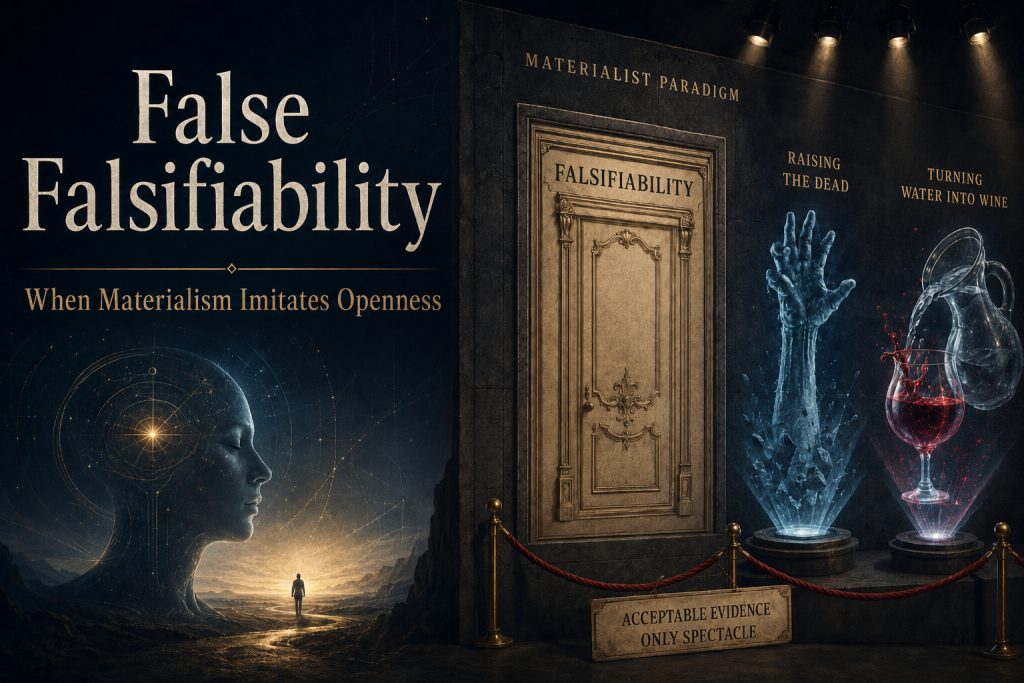
“That applies to the current moment. If the dead start rising or water starts turning into wine, then of course the picture will change. Religious experience itself is poorly falsifiable, and that is exactly the problem with it.”
On the surface, this answer looks reasonable. The person seems to be saying: “No, my worldview is not closed. There just are not enough grounds to change it yet. But if real facts appear, I will revise it.”
But this is exactly where the substitution happens.
Because the person does not show which facts could actually refute his frame. He simply invents several absurd, caricatured, theatrical examples in advance — “the dead rise,” “water turns into wine” — and presents that as falsifiability.
But that is not falsifiability.
That is an imitation of falsifiability.
Contents
- 1. A Caricatured Miracle Instead of a Real Criterion
- 2. Even These “Miracles” Would Not Refute Materialism
- 3. “Not Explained Yet” Becomes a Protective Shield
- 4. The Problem Is Not the Number of Facts, but the Rules for Admitting Facts
- 5. “Religious Experience Is Poorly Falsifiable” Is Another Substitution
- 6. Falsifiability Cannot Be Applied Selectively
- 7. “The Cultural Value of Religion” Is Not an Explanation of Its Origins
- 8. The Materialist Demands the Impossible from Religion, but Does Not Demand It from Himself
- 9. The Real Question: What Exactly Must Change?
- 10. Absurd Miracles Are a Convenient Protection from Real Questions
- 11. The Problem with Religious Experience Is Not That It Is “Poorly Falsifiable”
- 12. Openness Does Not Begin with the Phrase “I Am Ready to Change My Mind”
- 13. The Main Substitution
- 14. Conclusion
1. A Caricatured Miracle Instead of a Real Criterion
When a person says, “If the dead start rising,” he is not actually formulating a strict criterion for revising his worldview.
He is creating a caricature.
He takes religious reality not as a possible deep ontological structure, not as a question of consciousness, meaning, the source of being, the subject, inner experience, or the transcendent foundation of the world, but as a primitive trick:
- a corpse stood up;
- water became wine;
- a cloud started speaking;
- a statue blinked;
- someone walked through a wall.
In other words, religion is reduced in advance to a set of spectacular violations of familiar physics.
And then the person says: “If something like that happens, then I will believe.”
But this is already a substitution. Because religion is not reducible to a circus-like violation of physical expectations. God is not obligated to prove Himself in the format of a trick convenient for the materialist. Consciousness is not obligated to reveal its fundamentality through a zombie apocalypse. Meaning is not obligated to appear as a special effect.
The materialist frame first impoverishes the subject, turns it into a caricature, and then says: “Well, show me that caricature, and I will be open.”
This is not openness. This is control over the format of admissible evidence.
2. Even These “Miracles” Would Not Refute Materialism
The main problem is even deeper.
Even if events occurred that the materialist himself calls “sufficient,” they still would not necessarily refute his worldview.
Suppose a person saw a dead man rise.
What would he say?
Most likely, he would not say: “Materialism has been refuted.”
He would say:
- it was a mistaken death diagnosis;
- the person was in a coma;
- this is an unknown medical phenomenon;
- this is fraud;
- this is a collective hallucination;
- this is edited footage;
- this is psychotropic influence;
- this is an experiment with neurotechnology;
- this is an unknown form of biological regeneration;
- this is alien technology;
- this is a simulation;
- this is currently unexplained, but science will explain it in the future.
The same applies to water turning into wine.
The materialist almost certainly would not say: “Therefore, God exists.”
He would say:
- chemical reaction;
- liquid substitution;
- unknown nanotechnological process;
- experimental technology;
- trick;
- perceptual error;
- unreliable testimony;
- we do not know yet, but a natural explanation will be found.
And this is where the main thing is exposed.
The person says: “If water turns into wine, I will revise my worldview.”
But if this actually happens, his frame will still be able to say: “This is simply an unknown physical process.”
That means even his own examples are not real falsifiers.
They are only theatrical examples of a strange event. But a strange event does not yet destroy the materialist frame if that frame already allows for an infinite deferred explanation:
“We do not know yet, but someday science will explain it.”
And that is no longer falsifiability. That is a credit of faith issued to materialism for an infinite term.
3. “Not Explained Yet” Becomes a Protective Shield
The materialist frame very often protects itself not through proof, but through the promise of a future explanation.
The scheme is simple:
- There is a phenomenon that does not fit the current model.
- Instead of acknowledging the problem, the person says: “Science has not explained this yet.”
- Then he adds: “But that does not mean an explanation will not be found.”
- After that, the phenomenon remains inside the materialist frame as “temporarily unexplained.”
- The frame does not change.
This can digest almost anything.
Religious experience? Brain activity.
Mystical experience? Neurochemistry.
Consciousness? Emergent property.
Meaning? Product of cognitive processing.
Love? Biology of attachment.
Freedom? Illusion of choice.
Morality? Evolutionary strategy.
God? Cultural construct.
Miracle? Currently unknown physical mechanism.
In such a system, nothing can become a refutation. Any phenomenon is translated in advance into a category compatible with materialism.
And then the phrase “I am ready to change my worldview” becomes an empty declaration. Because inside the system itself there is no real entrance for a fact that could receive the status of a refuting fact.
4. The Problem Is Not the Number of Facts, but the Rules for Admitting Facts
A naive person thinks the argument is about facts.
But most often, the argument is not about facts. It is about the rules by which facts are admitted.
A fact does not arrive with a sign saying: “I refute materialism.”
Every system interprets a fact through its own initial categories.
If a person already believes that everything that exists must, by definition, have a material explanation, then no experience will be able to move beyond that frame. It will simply be renamed.
That is why the question should not be asked like this:
What facts are you ready to see?
It should be asked like this:
What facts in your system can even receive the status of facts, instead of being written off in advance as illusion, error, brain activity, culture, psychology, or unknown physics?
That is the real question.
Because if religious experience cannot be accepted in advance as testimony about reality, if consciousness cannot be recognized in advance as fundamental, if meaning cannot be recognized in advance as primary, if everything must be reduced in advance to matter, then there is no openness.
There is only a closed interpretive machine.
5. “Religious Experience Is Poorly Falsifiable” Is Another Substitution
The phrase “religious experience is poorly falsifiable” also sounds rational, but it hides a serious substitution.
Because religious experience is not a scientific hypothesis in the narrow laboratory sense.
It is an experience of consciousness.
And an experience of consciousness is not falsified in the same way as a physical hypothesis.
For example, if a person says, “I feel pain,” we do not demand from him a laboratory falsification of pain as an external object. We can look for correlates in the brain, measure reactions, observe behavior, but pain itself is given directly to the subject.
If a person says, “I love,” we do not say: “Love is poorly falsifiable, therefore there is a problem with it.”
If a person says, “I see meaning,” we cannot simply discard this as unfalsifiable, because meaning is not an object of the same type as a stone, a molecule, or an electric charge.
Consciousness, pain, love, meaning, inner experience, religious experience — these are not objects of the same class as laboratory bodies.
They require another epistemology.
And if the materialist says, “I accept only what can be verified within the framework of external observation,” he is not proving the falsity of inner experience. He is simply excluding inner experience from admissible reality in advance.
This is not neutrality.
This is methodological censorship.
6. Falsifiability Cannot Be Applied Selectively
The most interesting part begins when we turn the question back.
The materialist says:
Religious experience is poorly falsifiable.
Good.
But is materialism itself falsifiable?
What experience could refute it?
If any religious experience is declared brain activity, any mystical experience is declared an altered state of consciousness, any phenomenon of meaning is declared a cognitive construction, any miracle is declared unknown physics, any testimony is declared unreliable perception, any inner knowledge is declared subjective illusion, then where is the criterion for refuting materialism itself?
There is none.
Materialism in this version turns out to be better protected than any religion.
It says:
Everything that exists is ultimately material or explainable through material processes.
And when something appears that has not been explained materially, it says:
This simply has not been explained materially yet.
This is a logical circle.
Materialism declares itself the frame of everything possible, and then calls any problem inside this frame a temporary difficulty.
That is not how knowledge works.
That is how ideology works.
7. “The Cultural Value of Religion” Is Not an Explanation of Its Origins
There is another substitution inside the phrase:
“From the atheist’s point of view, the value of the origins of religion is exclusively cultural.”
Here, the origins of religion are translated in advance into the category of culture.
But culture is not an explanation of the origin of religious experience. It is already a later form of its manifestation.
Religious experience can be expressed through culture, language, ritual, myth, symbol, and tradition. But this does not prove that its source is only cultural.
That would be like saying:
Love is expressed through poems, songs, letters, ceremonies, and family traditions; therefore, love has exclusively cultural value.
No.
Culture can be a form of expression. But the form of expression is not identical to the source of the phenomenon.
The same applies to religion.
The fact that religion exists in cultural forms does not prove that its origin is exclusively cultural.
It is simply the placement of a phenomenon into a convenient category.
And then that category is presented as an explanation.
8. The Materialist Demands the Impossible from Religion, but Does Not Demand It from Himself
The materialist often demands from religion a standard of proof that materialism itself does not satisfy.
He says:
Show me an objective, repeatable, external, verifiable fact.
But when it comes to his own frame, he no longer applies the same strictness.
Consciousness has not been derived from matter — but he continues to believe that it somehow arises from the brain.
The subject has not been explained through physics — but he continues to speak of the subject as a function of neurons.
Meaning has not been reduced to matter — but he continues to call it a product of cognitive processes.
The quality of experience has not been explained through quantitative physical parameters — but he continues to believe that someday this will be explained.
In other words, religion receives the demand: prove it now and definitively.
But materialism receives infinite credit: it has not proven it now, but someday it will.
This is not rationality.
This is the privilege of one’s own frame.
9. The Real Question: What Exactly Must Change?
If a person says, “I will change my worldview if facts appear,” the question should not be about the dead or about water.
The question should be more precise:
What exactly must happen for you to recognize that consciousness is not derived from matter?
What exactly must happen for you to recognize that religious experience can be not a brain error, but contact with reality on another level?
What exactly must happen for you to recognize that meaning is not a by-product of neurons?
What exactly must happen for you to recognize that the material picture of the world is not neutral, but is one philosophical frame among others?
What exactly must happen for you to recognize that methodological naturalism is not an objective zero, but a rule of interpretation?
If a person cannot answer these questions, his worldview is not open.
It simply masks its closedness as readiness for fantastic special effects.
10. Absurd Miracles Are a Convenient Protection from Real Questions
The phrase about “the dead” and “water into wine” is convenient precisely because it moves the conversation away from the real nodes.
The real nodes are these:
- what consciousness is;
- what the subject is;
- what meaning is;
- why distinction exists at all;
- why there is not merely matter, but experienced reality;
- why physical description does not contain inner experience;
- why correlation between brain and consciousness is not an explanation of consciousness;
- why culture can be a form of religion, but not proof of its source;
- why methodological naturalism limits the field of the admissible in advance.
But instead of this, the person says:
Well, if the dead start rising…
This is a convenient caricature. It translates a deep ontological question into the image of a cheap horror movie.
That is exactly how substitution works: instead of discussing the foundation of reality, a grotesque example is slipped in, one that can easily be presented as absurd.
11. The Problem with Religious Experience Is Not That It Is “Poorly Falsifiable”
The problem of religious experience for the materialist is not that it is poorly falsifiable.
The problem is that it is inconvenient for the materialist frame.
Because religious experience points to the possibility that consciousness may be not just an observer inside the material world, but a participant in a deeper structure of reality.
It points to the possibility that meaning may be not derivative of matter, but an independent dimension of being.
It points to the possibility that the subject may be not an illusion, not a function of the brain, not a biological interface, but a fundamental participant in reality.
That is exactly why religious experience must be neutralized in advance.
It must be called:
- culture;
- psychology;
- hallucination;
- neurochemistry;
- evolutionary mechanism;
- cognitive error.
Not because this has been proven.
But because otherwise the frame begins to crack.
12. Openness Does Not Begin with the Phrase “I Am Ready to Change My Mind”
Openness does not begin with a declaration.
Not with the phrase:
“I am ready to change my worldview.”
Openness begins with an honest answer to the question:
What does my system forbid me to see?
This is where real philosophical honesty begins.
Not in the fact that a person is ready to acknowledge resurrected corpses if they suddenly appear under his window.
But in whether he is capable of seeing his own frame as a frame.
Whether he is capable of recognizing that his “rationality” already contains initial assumptions.
Whether he is capable of recognizing that “culture,” “brain,” “hallucination,” “cognitive distortion,” and “evolutionary function” are not neutral explanations, but ways of keeping a phenomenon inside a preselected worldview.
Whether he is capable of recognizing that materialism also requires falsifiability.
And if it does not require it, then it has long been operating not as knowledge, but as a closed ideological system.
13. The Main Substitution
The main substitution here is this:
the person talks about falsifiability, but in reality protects an unfalsifiable frame.
He says:
“If strong facts appear, I will change my mind.”
But at the same time, any real experience that could be a strong fact is deprived of the status of fact in advance.
Religious experience? Subjective.
Mystical experience? Neurochemistry.
Consciousness? Brain.
Meaning? Culture.
Miracle? Unknown physics.
God? Psychological projection.
And after that he says:
“Well, if the dead start rising…”
But this is not a criterion.
This is a performance.
The real criterion should not be which fantastic special effect the materialist is ready to see, but whether his system contains any possibility at all of recognizing a non-material, meaning-based, conscious, or transcendent level of reality.
If there is no such possibility, then there is no openness.
There is only a closed system in advance that calls its closedness rationality.
14. Conclusion
Falsifiability is not the ability to invent an absurd example.
Falsifiability is the presence of a real condition under which your model can be recognized as insufficient or false.
If a person says, “I will revise my worldview when the dead start rising,” but at the same time would explain any possible event through unknown physics, perceptual error, the brain, culture, or future science, then he has not given a criterion.
He has simply placed a decorative door in a wall, and that door opens nowhere.
The real question to the materialist sounds like this:
What exactly do you recognize as a fact capable of refuting materialism?
Not a strange event.
Not a currently unexplained phenomenon.
Not a reason to say “science will figure it out later.”
But specifically a fact after which you would say:
my initial frame was insufficient.
If there is no such fact, then materialism in this version is not open knowledge.
It is an ideology that has learned to speak the language of openness.
And that is exactly why the phrase “I will change my worldview if facts appear” often turns out to be not a sign of honesty, but a way of hiding the main thing:
facts are admitted only when they have already been neutralized by the frame.


