There is a typical rhetorical move often used by atheists, materialists, and pop-science rationalists when the conversation turns to God, religious experience, or the origins of religion.
They are told:
Belief in God and belief in deities are not the same thing. The question may not be about mythological characters, not about Zeus, Apollo, Poseidon, or some local spirit, but about the fundamental ground of reality, consciousness, meaning, being, and the very order of the world.
And they respond with something like this:
I do not believe in any deities. Not in the Christian one, not in the Muslim one, not in the Jewish one, not in any others either. What exactly is being substituted here?
At first glance, this response seems honest and consistent. The person appears to be saying: I simply do not believe in any version of a supernatural being. For him, all these variants belong to one category: “deities.” Some call it God, others Allah, others Yahweh, others something else. But for the atheist, all of this is one class of objects whose existence he does not believe in.
And this is precisely where the substitution happens.
The problem is not that the person does not believe. He has the right not to believe. The problem is how exactly he classifies the subject of the conversation in advance.
He does not ask:
- what exactly do you mean by God?
- are we talking about a mythological character or about the ultimate ground of being?
- are we talking about a being inside the world or about the ground of the world itself?
- are we talking about a cultural figure or about the structure of consciousness?
- are we talking about a fantasy object or about the primary source of meaning, distinction, and order?
He does none of this.
He immediately says:
“I do not believe in any deities.”
That is, before any analysis of the subject, he has already placed it into the category of “deities.”
And after that, everything becomes very convenient.
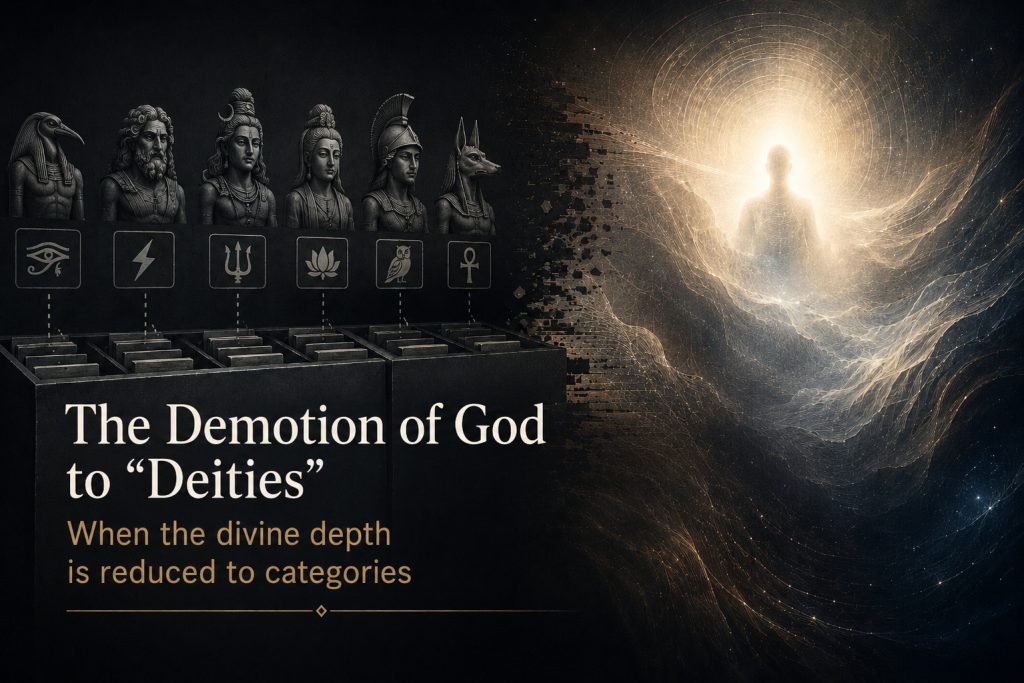
If God is named a “deity” in advance, then God can be treated as one mythological object among others. Then the Christian God, the Muslim God, the Jewish God, Greek gods, Roman gods, spirits, demons, fairies, trolls, dragons, and other beings can easily be thrown into one pile. After that, the person can say:
“Well, I simply do not believe in all that.”
And it looks as if he has made a rational conclusion.
But in reality, he has not made a conclusion. He has simply chosen in advance a category in which the desired conclusion is already built in.
Contents
- 1. The Substitution Begins with Classification
- 2. He Is Not Arguing with God — He Is Arguing with a Caricature He Created in Advance
- 3. Belief in God and Belief in Deities Are Not the Same Thing
- 4. This Is Not Honest Skepticism, but a Preconfigured Filter
- 5. The Question of Reality Is Substituted with the Question of Belief
- 6. The Materialist Frame Presents Itself as Neutrality
- 7. Why the Question “What Is Being Substituted Here?” Is Itself Part of the Substitution
- 8. He Does Not See the Depth Because He Cuts Off the Depth in Advance
- 9. Such a Position Is Unfalsifiable
- 10. The Real Question That Should Be Asked
- 11. Conclusion
1. The Substitution Begins with Classification
The main manipulation here is that the person presents classification as if it were a neutral description.
He says:
“I do not believe in any deities.”
But the word “deities” is already not neutral. It already sets the frame.
A deity is usually something like a supernatural character, a being, an agent, an object of belief, a mythological figure, an entity that people worship. This category is connected with mythology, religious studies, cultural anthropology, and the external description of religion.
But the question of God in the philosophical, metaphysical, or ontological sense may be something completely different.
God may be understood not as “one being among others,” but as the ground of existence itself.
Not as a character inside the world, but as the source of the world.
Not as an object among objects, but as that through which objects, order, meaning, consciousness, distinction, and being become possible at all.
And when a person names all of this a “deity” in advance, he is not refuting the idea of God. He is merely reducing it to a category that is more convenient for him.
This is not an argument.
It is an operation of flattening the subject.
2. He Is Not Arguing with God — He Is Arguing with a Caricature He Created in Advance
When a materialist says, “I do not believe in any deities,” he is often not arguing with what his interlocutor is actually claiming.
He is arguing with an image that he himself has created.
The scheme works like this:
- First, God is translated into the category of “deity.”
- Then “deity” is translated into the category of “mythological being.”
- Then the mythological being is placed next to Zeus, Thor, Osiris, fairies, or dragons.
- Then the person says: “Well, obviously, I do not believe in all that.”
- And after that he thinks he has refuted a religious or metaphysical position.
But he has not refuted it.
He has simply replaced it with a weaker, more primitive, and more convenient version.
This is a classic substitution: instead of the real subject of discussion, a caricatured model of it is taken, and then that caricature is refuted.
That is, he does not show that the idea of God is false.
He shows that his own caricature of God looks absurd.
But that is not an achievement of thought. It is a rhetorical trick.
3. Belief in God and Belief in Deities Are Not the Same Thing
Belief in deities usually means belief in separate supernatural beings that have names, characters, functions, spheres of influence, and mythological biographies.
Zeus is responsible for one thing, Poseidon for another, Ares for a third, Aphrodite for a fourth. This is a pantheon, a distribution of roles, a mythological structure, a cultural system of images.
But belief in God in the monotheistic, philosophical, or metaphysical tradition does not necessarily mean belief in “one big character instead of many little characters.”
This is an entirely different level of the question.
The issue may be the first ground of being.
The reason for the existence of the world.
The ultimate source of order.
Consciousness as a fundamental component of reality.
Meaning that cannot be reduced to matter.
The fact that matter by itself does not explain consciousness, laws, the mathematical structure of the world, or the very distinction of objects.
And when a person responds to this with the phrase “I do not believe in any deities,” he does not even enter this level of discussion.
He remains at the level of external classification.
For him, everything is already placed in the folder called “religious beings.”
And everything that has entered that folder is already considered invalid.
4. This Is Not Honest Skepticism, but a Preconfigured Filter
Honest skepticism must first understand what exactly is being claimed.
It must distinguish levels.
For example:
- God as a mythological character;
- God as a cultural image;
- God as a personal Absolute;
- God as the ground of being;
- God as the source of consciousness;
- God as ultimate meaning;
- God not as an object inside the world, but as the condition of the possibility of the world.
One may disagree with any of these positions. One may criticize them. One may reject them. But first one must at least understand which exact position is being discussed.
And when, instead, a person says “I do not believe in any deities,” he does not distinguish. He throws everything into one category.
This is exactly the FlatMind mechanism: not to distinguish structure, but to recognize a familiar label.
Saw the word “God” — put it into the folder “deities.”
Saw the word “religion” — put it into the folder “mythology.”
Saw religious experience — put it into the folder “hallucinations,” “cognitive distortions,” “culture,” “brain activity.”
And then said:
“I am open to facts.”
But this is false openness.
Because the facts already pass through a preinstalled filter. Any phenomenon receives in advance an acceptable materialist interpretation. And if a phenomenon can be called a hallucination, a cultural construct, or brain activity, then it will never become a fact against the materialist frame.
That is, the person is not open to facts.
He is open only to those facts that have already passed through his system of classification.
5. The Question of Reality Is Substituted with the Question of Belief
Another substitution consists in shifting the question of reality into the question of personal belief.
He is being told about God as a possible ground of reality.
And he answers:
“I do not believe.”
But the question is not what he believes or does not believe.
The question is whether his system of distinction is adequate.
If a person does not believe in God, this proves nothing. It is simply the state of his worldview.
But when he calls God a “deity,” and then refuses to believe in “any deities,” he is not merely making a personal confession. He is performing an operation of classification.
He is, in effect, saying:
“I already know which class the thing you are talking about belongs to. It belongs to the class of fictional supernatural objects. I do not believe in such objects.”
And here the question arises:
on what grounds did he decide that God belongs precisely to this class?
Was this proven?
Was this derived logically?
Was this analyzed?
Or is it merely an automatic reaction of his ideological frame?
6. The Materialist Frame Presents Itself as Neutrality
The biggest problem is that the materialist usually does not see his frame as a frame.
He thinks he is simply looking at the world “as it is.”
The religious person, in his view, believes.
But he supposedly does not believe.
The religious person is inside a worldview.
But he supposedly stands outside it.
The religious person interprets.
But he supposedly merely records facts.
But this is false.
The materialist is also inside a frame. He also classifies reality through initial assumptions. He also decides in advance which types of explanation are permissible and which are not.
If only material, neurophysiological, cultural, and evolutionary explanations are permissible in his system, then any religious experience will be processed in advance inside these categories.
It will not be able to become a challenge to the system.
Because the system already knows how to neutralize it.
A person experienced an encounter with God?
That is subjective experience.
A person experienced an answer to prayer?
That is coincidence.
A person experienced a miracle?
That is an error of perception.
A person speaks of consciousness as fundamental?
That is philosophical speculation.
A person says that matter does not explain distinction?
That is a misunderstanding of science.
A person says that God is not a mythological deity, but the ground of being?
That is simply another interpretation of a deity.
And that is it. The system has closed itself.
7. Why the Question “What Is Being Substituted Here?” Is Itself Part of the Substitution
When he asks:
“What is being substituted here?”
he pretends that the substitution must be located at the level of dictionary mismatch.
As if he were saying:
“I said I do not believe in the Christian God, the Muslim God, or the Jewish God. I did not confuse anyone. I listed all of them. Where is the substitution?”
But the substitution is not that he confused the names of religions.
The substitution is that he reduced different levels of the conversation in advance to one class: “deities.”
The Christian God, the Muslim understanding of God, and the Jewish understanding of God are not simply three different “deities,” like different characters in a catalogue of mythological beings.
They are different traditions of thinking about the ultimate ground of reality.
One may argue with these traditions. One may criticize them. One may reject them. But one cannot honestly replace them with a “set of deities” and then say: “I simply do not believe in any of them.”
This is not analysis.
This is reduction.
8. He Does Not See the Depth Because He Cuts Off the Depth in Advance
The main point is this:
the person does not try to understand what is being discussed.
He does not enter the depth of the subject.
He immediately performs a classificatory action:
God = deity.
Deity = supernatural object of belief.
Supernatural object of belief = unproven fantasy.
Therefore, I do not believe.
But in this chain everything has already been decided in advance.
It does not investigate reality. It protects the frame.
It does not ask whether consciousness may be fundamental.
It does not ask whether meaning may be more primary than form.
It does not ask whether matter may be stabilized meaning.
It does not ask whether God may mean not an object inside the world, but the ground of the very possibility of the world.
It does not ask why laws, mathematics, distinction, order, subjectivity, and experience exist at all.
It simply says:
“Deities. I do not believe.”
This is not thinking.
This is automatic sorting.
9. Such a Position Is Unfalsifiable
If any possible encounter with religious, spiritual, or metaphysical experience is translated in advance into a materialist category, then the model becomes unfalsifiable.
It can always say:
- this is a hallucination;
- this is a cultural construct;
- this is brain activity;
- this is a memory error;
- this is a coincidence;
- this is the effect of suggestion;
- this is an evolutionary mechanism;
- this is mythological thinking;
- this is a need for comfort.
Then the question arises:
what phenomenon could ever refute this model?
If the answer is: “none, because any phenomenon will still be explained inside the materialist frame,” then this is no longer open rationality.
It is ideology.
And it is an ideology that does not recognize itself as ideology.
It considers itself neutral common sense.
And that is precisely why it is especially dangerous.
10. The Real Question That Should Be Asked
There is no need to ask such a person:
“Do you believe in God?”
That is too weak a question. He will simply answer:
“No, I do not.”
The real question is different:
Does there exist, within your worldview, any phenomenon that you could in principle recognize as pointing toward God, consciousness as a fundamental reality, or a non-material ground of being?
And even more precisely:
What exact observations, within your system, can receive the status of refuting materialism?
If there are no such observations, then the person is not open to facts.
He has simply declared in advance that one class of explanations is permissible and another is impermissible.
In that case, his phrase “I do not believe in any deities” is not the result of honest analysis.
It is a password of belonging to a frame.
It is a signal: everything religious, spiritual, and metaphysical has already been sent in advance to the trash bin labeled “deities.”
11. Conclusion
When a person says:
“I do not believe in any deities — not in the Christian one, not in the Muslim one, not in the Jewish one, not in any others either,”
he may think he is speaking rationally and honestly.
But in reality, he has already performed several operations:
- He has defined God in advance as a “deity.”
- He has mixed the philosophical question of the ultimate ground of being with the mythological category of supernatural beings.
- He has substituted analysis with classification.
- He has substituted depth with a label.
- He has substituted the question of reality with the question of personal belief.
- He has kept the materialist frame untouchable.
- He has presented his own frame as neutral common sense.
This is precisely the substitution.
The problem is not that he does not believe.
The problem is that he decides in advance what the thing he does not believe in is.
And then he presents this as honest skepticism.
But honest skepticism does not begin with the phrase “I do not believe in any deities.”
Honest skepticism begins with the question:
what exactly am I calling a “deity” right now — and am I not destroying the subject of the conversation through the very way I name it?
Until this question is asked, there is no honest rationality here.
There is only the disguised classificatory power of the materialist frame, which decides in advance what may count as reality and what must be written off as mythology.


